
What Meta’s Smart Glasses Ban Teaches Marketers About Trust
By Cap Puckhaber, MarketingSpiritual.com, Reno, Nevada
Meta banned a wave of harassment videos from Instagram this month. The videos were filmed with the company’s Ray-Ban smart glasses. Two accounts with more than a million followers each got kicked off the platform for it, since both used the hardware to target strangers in public. If you sell software or run a coffee shop, this story might feel far away from your work. It isn’t far away at all.
Every brand collects some form of customer data. Each campaign asks people to trust a company with information about themselves. That might be an email address, a home address, or a photo taken on a public sidewalk. Meta’s smart glasses controversy shows what happens when a useful product treats privacy as an afterthought. I’ve watched plenty of campaigns rise and fall on trust alone. This case study lays out that pattern better than almost anything else in tech right now.
Small business owners often assume these stories belong to a different world. That world seems built around billion-dollar hardware bets and celebrity endorsement deals. But the underlying mechanics are identical no matter the size of the company. A local dentist collecting patient emails and a trillion-dollar tech company selling AI glasses make the same basic promise to customers. So the real question is simple. What happens to someone’s information once they hand it over? Does the business treat that handoff as a privilege, or as raw material?
I’ll walk through what happened with Meta’s glasses, why the backlash spread fast, and what it means for any campaign that touches customer data. Since the story is still unfolding, I’ll stick to what’s been confirmed by reporters and Meta itself. None of this requires you to sell hardware to matter for your business.
A quick history of Meta’s bet on smart glasses
Meta didn’t stumble into wearable cameras by accident. The company partnered with Ray-Ban’s parent company, EssilorLuxottica, back in 2021. Together they released Ray-Ban Stories, a clunky first attempt most people forgot within a year. Since customer feedback was rough, Ray-Ban Meta launched next with a sharper design and a better camera. It shipped with a built-in AI assistant, and it actually caught on. EssilorLuxottica had sold two million pairs of the Gen 1 glasses since release, by its own reported figures.
Sales didn’t slow down after that milestone. The company reported selling more than seven million smart glasses in a single year, since demand kept climbing quarter over quarter. That’s close to tripling the prior year’s numbers. Industry analysts now put Meta’s share of the global smart glasses market somewhere between 76 and 82 percent.
Meta is reportedly targeting 10 million wearables sold in the second half of this year alone. So the broader industry is expected to ship roughly 13.4 million units total. That’s not a niche gadget category anymore. It’s a mainstream electronics business with real revenue behind it.
The product still has rough edges, though. Continuous use of the live AI features drains the battery in about 30 minutes on current models, so most people treat the glasses as an occasional tool rather than an all-day companion. Even so, that limitation hasn’t slowed adoption much, since most buyers use the camera and audio features far more than the AI assistant itself.
From Ray-Ban Stories to a Kylie Jenner line
The product line kept expanding fast. Oakley Meta HSTN and Oakley Meta Vanguard brought the same camera and AI features to a sportier frame. An $799 Meta Ray-Ban Display added a heads-up screen for notifications and navigation. Meta and EssilorLuxottica then launched a broader Meta Glasses collection this summer. That collection includes a $399 Starfire edition designed with Kylie Jenner. Prescription options followed soon after, priced at $499 and built for opticians to fit and adjust.
This is a very different outcome than Google’s last attempt at the category. Google Glass launched with plenty of hype back in 2013. It got pulled from the consumer market within two years, undone by privacy backlash. Meta learned from that failure in one important sense, since it built a product people actually wanted to wear every day.
Google never managed to pull that off. But Meta hasn’t solved the exact same problem that killed Google Glass in the first place. What happens to the people standing near the camera who never agreed to be filmed?
What actually happened with the harassment ban
The immediate trigger for this story was a new Instagram policy. Since July, the platform has been removing videos that use Meta’s smart glasses to harass people in public. Instagram head Adam Mosseri addressed the issue directly in a public post. He explained the platform would remove content showing people taking advantage of strangers. That includes the pickup-line videos that had become common on the app. He added that Meta didn’t want people secretly filming and harassing others for content. The company said it was fighting that behavior in every way it could manage.
Business Insider first reported that two pickup-artist accounts had already been deactivated. Each had more than a million followers. Both had posted glasses footage of women approached in public without consent. A Meta spokesperson confirmed both accounts were removed for violating the new policy. The company did not explain how enforcement would work going forward. It didn’t say what specifically counts as a violation, and it stayed silent on how many accounts had been affected beyond those two cases.
The backlash had been building for a while before this policy landed. Critics had already started calling the product “pervert glasses.” That nickname stuck after a wave of videos showed men filming women without asking first, at gyms, in stores, and on the street. Prank accounts added a second problem. They used the glasses to ambush retail and service workers with staged confrontations designed to go viral. Both genres relied on the exact same feature. A recording device disguised as an ordinary pair of sunglasses, one most bystanders never think to question.
The gaps nobody’s talking about
Meta’s response so far has focused almost entirely on the recording indicator. That’s a small white LED on the front of the glasses that lights up when the camera is active. Starting with the second generation hardware, covering that light disables the camera entirely. Meta announced an update in July that detects attempts to physically damage the light. That stops wearers from disabling it and filming anyway. The company also said it removes ads and marketplace listings that sell tampering kits.
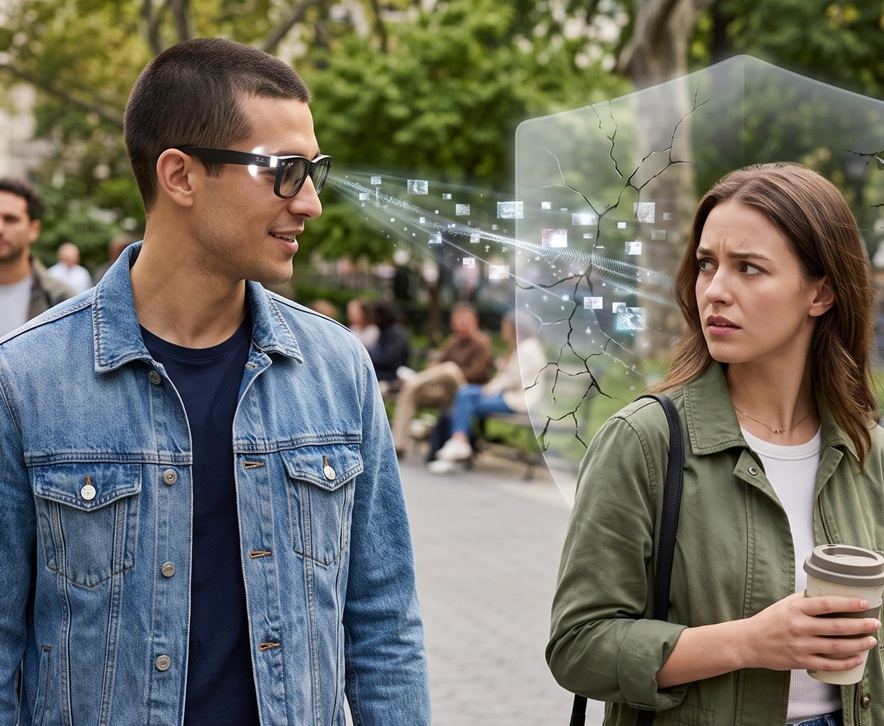
None of that creates an actual consent mechanism for the people being filmed. A stranger walking past someone wearing the glasses has no way to know footage exists. They’d need to notice a tiny light, and several outlets say it’s easy to miss outdoors. Once footage lands on a connected phone, the wearer can edit, crop, or delete it freely. Nobody else gets a say in that process. The person filmed never does either.
This tension runs deeper than an enforcement gap. Reporting has described a facial recognition tool called Name Tag. Meta had installed it on more than 50 million glasses before any public release. The company pulled it only after journalists surfaced the story.
Meta is simultaneously trying to police harassment on its platform. At the same time, it’s building the always-on recording and identification technology that makes harassment easier to pull off. That’s the real story here, and it’s a pattern marketers should recognize instantly. A company can publish all the community guidelines it wants. But if the product itself is designed around collecting information people didn’t agree to share, those guidelines just do damage control instead of prevention.
The Kylie Jenner campaign and the trust-washing backlash
Meta’s answer to a trust problem was a celebrity. This summer, Meta and EssilorLuxottica introduced the Starfire Kylie Edition. It’s a $399 pair of Meta Glasses designed with reality star and cosmetics entrepreneur Kylie Jenner. It ships with an AI assistant that speaks in her own voice. The launch video showed Jenner narrating her morning routine through the glasses. She directed household staff and made a smoothie while the camera captured everything around her. The pitch was aspirational lifestyle content, not privacy reassurance of any kind.
Public reaction went the opposite direction Meta wanted. Comments under the announcement called the product “predator glasses.” Some accused Meta of normalizing mass surveillance for profit. Because the criticism kept building, a UK activist group called Everyone Hates Elon installed a guerrilla ad campaign near Meta’s London office. The ad used a lenticular printing trick. Viewed from one angle, it showed Jenner’s promotional image, but head-on it revealed the warning “we’re always watching.” The stunt spread widely across social platforms within days.
Singer Lorde weighed in from the stage at a festival where Ray-Ban was a sponsor. She told the crowd not to buy AI glasses, without naming a specific brand. A content creator who says she was filmed without consent by someone wearing the glasses posted a video that drew millions of views. Her argument was pointed. She said the campaign wasn’t really designed to sell glasses to women at all. Instead, it existed to make the public more comfortable around men who already wear the glasses to record people without asking first.
Why celebrity trust rehab backfires
There’s a pattern here that shows up across industries far beyond tech. When a brand attaches a beloved, trusted face to a product with a real trust deficit, audiences notice the mismatch fast. Jenner’s involvement didn’t change how the hardware works, nor did it change what happens to footage once it’s captured. Instead, it added a friendly face on top of a design that critics say still treats consent as optional.
Reporting has described data annotation contractors reviewing glasses footage as part of training Meta’s AI systems. That means strangers caught on camera in public may have their images reviewed by workers on another continent. They’d never even know it happened. A celebrity endorsement can’t fix that structural issue. Audiences increasingly know the difference between a genuine product improvement and a marketing layer sitting on top of an unfixed problem. Cap Puckhaber has said for years that influencer partnership transparency only works when the product earns the trust the influencer is lending it. This campaign is a clear example of what happens when that order gets reversed.
I’ve seen smaller versions of this same mistake in local campaigns too. A restaurant client once hired a well-liked local reviewer to promote a new loyalty app, without fixing the app’s confusing data permissions first. Because the underlying product still felt invasive, the endorsement barely moved sign-ups, and a few customers even called out the mismatch in the reviewer’s comments section.
Where wearable tech goes from here
Meta isn’t the only company chasing this market anymore. Google has partnered with Warby Parker and Samsung to bring Android XR glasses to market. It’s following the same camera-and-AI formula that made Ray-Ban Meta successful. Snap has spun its augmented reality glasses effort into a standalone subsidiary ahead of a planned consumer launch. Apple is widely expected to enter the category too. Every one of these companies will face the identical problem Meta hasn’t solved. How do you build a product whose value depends on recording the world, while respecting people who never opted into being recorded?
Why regulators are watching now
Regulatory attention is catching up too. Lawmakers and privacy regulators have started asking pointed questions about recording indicators and biometric data collection. They’re also asking what recourse exists for people captured on camera without consent. State officials have raised public concerns about how platforms handle the safety risks these devices create for minors.
The stakes go beyond a single harassment policy. Reporting has noted that Meta’s facial recognition features made the Ray-Ban line popular within certain federal agencies, since the glasses can identify people on sight in ways a phone camera can’t. That detail matters for any brand watching this space, because it shows how quickly a consumer product can get pulled into surveillance debates it never planned for. None of this scrutiny is going to slow Meta’s sales growth in the short term. But it does raise the cost of getting privacy wrong later.
What this means for marketers watching from outside tech
The companies racing into this space are building products under a spotlight Google Glass never faced back in 2013. For marketers, the interesting part isn’t the hardware roadmap at all. It’s watching an entire industry get built in public.
Its biggest player is still struggling to answer one basic question. Does the person on camera get any vote in whether they’re recorded? Every brand entering the wearables category will have to answer that eventually. So the ones who answer it early will earn trust faster than the ones scrambling to catch up after backlash hits.
The lessons every marketer and small business owner needs
None of this means small businesses need to worry about smart glasses specifically. Most local shops and service businesses aren’t building wearable cameras or training AI models. What this case study offers instead is a much broader lesson. It’s about how trust gets built or destroyed, and that lesson applies just as much to an email list as it does to an AI headset.
Privacy-by-design isn’t a compliance checkbox you handle after launch. It’s a brand asset you either build in from the start, or bolt on too late to matter. Meta’s LED indicator and tamper detection are reactive fixes. They were layered onto a product that was designed first and questioned second. Customers can usually tell the difference between a company that thought about their comfort from day one, and one doing damage control after getting caught. The second kind rarely earns back the trust it lost, no matter how polished the apology looks.
My own mistake with customer data
I made a version of this mistake myself years ago, running email campaigns for a client in the home services industry. We added a location-tracking pixel to a promotional email without disclosing it clearly. It sat quietly on the signup form, meant to help us personalize follow-up offers by neighborhood. A handful of subscribers noticed the tracking behavior, so they called it out publicly in a local community group online. Because of that, the client lost around 400 subscribers in a single week, more than 12 percent of the entire list. We fixed the disclosure language within two days. Still, it took nearly four months to rebuild the list back to its original size.
The lesson stuck with me ever since that week. Consent isn’t a legal formality you paste into a footer and forget. It’s the actual difference between a customer feeling served and a customer feeling watched. Once someone crosses into feeling watched, no amount of clever copywriting brings them back quickly.
How to apply this at small scale
You don’t need Meta’s budget to apply these lessons inside your own campaigns. So start by auditing every place your business collects customer data. That means website forms, loyalty programs, and point-of-sale systems alike. Write down exactly what happens to that information after it’s collected. If you can’t explain the full lifecycle of a piece of customer data in plain language, your customers definitely can’t either. That gap is exactly where trust erodes fastest.
Consent and transparency also work as genuine differentiators, rather than mere legal cover for a business. A small business that clearly explains why it’s asking for a phone number tends to see higher sign-up rates. So does one that explains what the number will and won’t be used for. Compare that to a business that buries the request in fine print nobody reads. Leaning on first-party data collected with clear consent tends to outperform third-party tracking anyway. People who sign up on purpose engage more than people swept up by a hidden pixel.
Influencer partnerships and everyday touches
If you work with influencers or brand partners, apply the same standard Meta failed to apply with Jenner. A celebrity partnership can’t paper over a product your customers already distrust. Fix the underlying issue before you hire someone to promote it. I’ve seen campaigns spend five figures on an influencer partnership meant to fix a reputation problem. A two-line policy change would have solved it for free.
There’s a simple version of this you can run today, even without a marketing budget. If your business uses any camera, kiosk, or check-in system, post a short, plain-language note near it explaining what’s recorded and why. Since most customers have never been asked, a small gesture like that stands out. It also does more for trust than any tagline could, because it shows the choice is real rather than assumed.
The real takeaway
Meta’s glasses aren’t going away, and neither is the broader shift toward wearable, always-on technology. Sales numbers alone tell you this product category is here to stay. That’s true whatever happens with the harassment policy or the Kylie Jenner campaign specifically. What the backlash proves is different. Hardware and market share aren’t enough on their own anymore to guarantee lasting success.
Trust is the actual product now, more than the device wrapped around it ever was. A company can build the most capable camera glasses on the market. Yet it can still lose the room the moment people feel recorded without consent. Shifting toward a privacy-first marketing approach does more than manage risk.
Businesses that build direct, consented relationships with customers tend to understand those customers better than ones renting attention from a third party. Marketers and small business owners don’t need a wearable device to learn from that lesson. Audit how you collect and use customer data this week. Be upfront about it in your marketing. Treat consent as the thing that keeps people coming back, not an obstacle standing between you and a sale.
Since this story is still developing, expect more headlines about smart glasses, enforcement, and regulation in the months ahead. Whatever happens next, the businesses that already treat privacy as a feature will be the ones least affected by it. If you found this case study useful, keep following along, since the lessons from big tech’s privacy fights tend to reach small business marketing faster than people expect.
Frequently asked questions
What did Meta ban on Instagram?
Instagram started removing videos filmed with Meta smart glasses that harass strangers in public. That includes pickup-line videos and prank content aimed at service workers. Instagram head Adam Mosseri announced the policy himself. He confirmed that at least two large pickup-artist accounts, each with more than a million followers, had already been deactivated for violating it. Meta hasn’t published detailed enforcement guidelines. It remains unclear exactly how the company identifies violating content, or how many accounts have been affected beyond the two confirmed cases.
How many Meta smart glasses have been sold?
EssilorLuxottica, Meta’s hardware partner, reported selling more than seven million smart glasses in a single recent year. That’s close to tripling the prior year’s sales. Meta and EssilorLuxottica now hold an estimated 76 to 82 percent share of the global smart glasses market. The company is reportedly targeting 10 million units sold in the second half of this year alone. Analysts expect the broader smart glasses industry to ship roughly 13.4 million units across the year.
Is it legal to record people with smart glasses in public?
In most of the United States, recording video in a public place is generally legal. People don’t have a strong expectation of privacy while out in public. That legal reality doesn’t mean the practice is welcome or ethical. That’s exactly why Instagram’s new harassment policy exists alongside the law, not instead of it. Laws vary by state and country. Anyone using recording wearables commercially should check local regulations before filming strangers.
What can small businesses learn from Meta’s privacy backlash?
The biggest lesson is that privacy and consent function as brand assets. They’re more than legal requirements to satisfy quietly in the background of a business. Businesses that explain clearly what customer data they collect, and why, tend to earn higher trust and better sign-up rates. Those that treat disclosure as an afterthought don’t. Fixing a trust problem after backlash hits is far more expensive and slower than building transparency into a product or campaign from the very beginning.
Read more on Why Honesty and Transparency in Marketing Are Non-Negotiable
Check out How to Build and Earn Customer Trust with Data-Driven Insights
Check out 5 Simple Steps to More Transparent Marketing by Cap Puckhaber
More Blogs from Cap Puckhaber

Follow Cap Puckhaber on Social Media
- Connect with Cap Puckhaber on Facebook
- See Cap Puckhaber’s latest adventures on Instagram
- Read Cap Puckhaber’s thoughts on X
- Join the conversation on Threads
- Follow Cap Puckhaber on Mastodon
- Browse my Pins on Pinterest
- See my Marketing Articles on Medium
- Follow Cap Puckhaber’s Company Page on LinkedIn
- Check out Cap Puckhaber on BlueSky
- Follow Cap Puckhaber on Substack


Cap Puckhaber
Backpacker, Marketer, Investor, Blogger, Husband, Dog-Dad, Golfer, Snowboarder
Cap Puckhaber is a marketing strategist, finance writer, and outdoor enthusiast from Reno, Nevada.
He writes across CapPuckhaber.com, TheHikingAdventures.com, SimpleFinanceBlog.com, and BlackDiamondMarketingSolutions.com.
Follow him for honest, real-world advice backed by 20+ years of experience.