
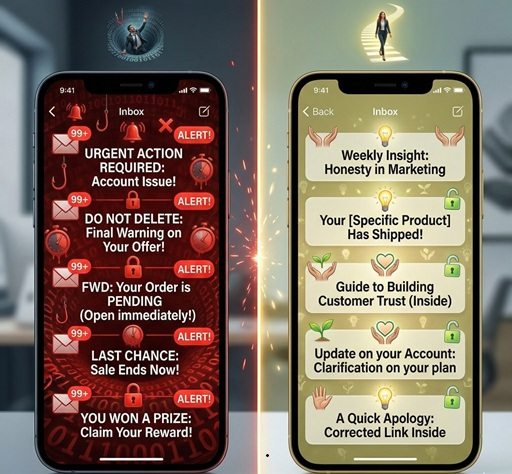
Beyond the Click, The Ethics of Truthful Subject Lines in Email Marketing
By Cap Puckhaber, MarketingSpiritual.com, Reno, Nevada
Updated: 10/31/26
Every email you send makes a small promise before the reader ever opens it. That promise lives in the subject line. When the email delivers what the subject line said, trust grows a little. But when it doesn’t, the reader learns to doubt you, and they rarely forget it.
I’ve spent a big part of my career in email and lifecycle marketing, including my years at Audible. In that time, I’ve watched plenty of clever subject lines win the open and lose the customer. This post covers what I’ve learned about writing subject lines that are honest and still get opened. You’ll also find the legal baseline, the deliverability risks and a mistake of my own that taught me more than any A/B test.
A subject line is a promise you make before hello
Why I stopped treating open rates as the scoreboard
Open rate is the easiest email number to move and the easiest one to fake. A shocking subject line will almost always beat a plain one on opens. But opens don’t pay the bills. Clicks, replies, purchases and long-term subscribers do, and tricks tend to hurt all of those.
Open rates have also become less reliable as a metric. Apple’s Mail Privacy Protection loads tracking pixels automatically for many users, so a lot of recorded opens never involved a human reading anything. If you optimize for a number that’s partly made up, you’ll make bad decisions. I’d rather judge an email by what people did after they opened it.
So when a client shows me a subject line that doubled their open rate, my first question is about clicks. My second question is about unsubscribes and spam complaints. More often than not, the trick that lifted opens also lifted complaints. That’s a trade nobody should accept once they see the full picture.
The trailhead sign problem
I spend a lot of weekends hiking, and trail signs taught me something about subject lines. Picture a sign that says the lake is two miles away. You set off, and two miles later there’s no lake. Three more miles pass before you finally see water. You made it, but you’ll never trust that sign again, and you’ll warn your friends about it.
A misleading subject line works the same way. The reader still got somewhere, but the trip didn’t match what they were told. Next time your name shows up in their inbox, they’ll remember that feeling. Some will skip the email, while others will hit the spam button. Honest signs build hikers who come back, and honest subject lines build readers who come back.
The best trail signs I’ve seen are almost boring. They give the distance, the elevation gain and maybe a warning about a creek crossing. Nobody needs a trail sign to be exciting. They need it to be right, and readers want the same thing from your inbox.
The deceptive tricks I see most often
Fake replies and fake forwards
One of the most common tricks is adding a fake RE or FWD prefix to a marketing email. The goal is to make the reader think they’re already in a conversation with you. It works for exactly one open. After that, the reader realizes they never wrote to you, and the feeling turns from curiosity to annoyance.
I’ve seen small businesses copy this tactic because a big brand did it. That’s a bad reason to do anything. A large brand with millions of subscribers can absorb a few thousand angry readers. Your local bakery or consulting firm can’t, because your list is built one real relationship at a time.
The same goes for subject lines that pretend to be personal notes, like “Quick question” from someone the reader has never met. If the email really is a quick personal question, that’s fine. A sales pitch dressed up as a question will leave the reader feeling tricked.
False urgency and countdowns that never end
Urgency works, and that’s exactly why it gets abused. “Last chance” and “Ends tonight” are honest when the offer actually ends tonight. They’re dishonest when the same sale shows up again next week with a new deadline. Readers notice the pattern faster than marketers think.
Countdown timers inside emails have the same problem. Some reset every time someone opens the message, so the deadline never arrives. I won’t build those for clients, even when they ask. Once a reader catches a fake deadline, every future deadline from that brand loses its power.
My rule is simple. If the deadline is real, say it plainly and stick to it. When you extend a sale, tell people you extended it and why. That kind of honesty costs a little urgency, but it keeps your next real deadline believable.
Bait and switch openers
Bait and switch is the subject line that promises one thing and delivers another. A classic example is “Your free gift is waiting” when the gift requires a purchase. Another is “We need to talk” when the email is a routine product announcement. The subject line wins the open, and the body loses the reader.
Ask yourself one question before you hit send. Would a reader who opened this email feel the subject line was fair? If the answer is anything other than yes, rewrite it. That single check catches most bait and switch problems before they reach anyone’s inbox.
Preview text deserves the same scrutiny. Most inboxes show a line or two of preview text right next to the subject line, and readers treat the two as one message. A subject line can be accurate while the preview text oversells, and the reader still feels misled. I write both together and read them out loud as a pair before anything gets scheduled.
What the law actually says about subject lines
CAN-SPAM in plain English
In the United States, commercial email falls under the CAN-SPAM Act, which the Federal Trade Commission enforces. According to the FTC’s CAN-SPAM compliance guide for business, your subject line must accurately reflect the content of the message. Your from, to and reply-to details also have to be accurate. That means the email must clearly identify the person or business sending it.
The penalties are real. According to the FTC, each separate email in violation can bring penalties of up to $53,088. If you send a misleading campaign to a few thousand people, the math gets scary fast. Most small businesses will never face an enforcement action, but I wouldn’t build a strategy on that hope.
The law covers more than subject lines too. You need a clear way for people to unsubscribe, and you must honor those requests within 10 business days. Your unsubscribe link has to keep working for at least 30 days after you send. You also need to include a valid physical postal address. None of this is hard, yet I still find businesses missing at least one of these pieces during audits.
I’m a marketer and not a lawyer, so treat this as a starting point. Rules also differ outside the United States, and some countries require consent before you email anyone at all. If your business sends a lot of email or operates in other countries, talk to an attorney who handles marketing law.
Where legal stops and honest starts
Being legal is the floor, and plenty of manipulative subject lines stay just above it. A subject line can technically describe the email’s content and still be designed to confuse. “Your account update” might be accurate if the email mentions an account, even when it’s really a promotion. That passes a legal test and fails an honesty test.
I hold my clients to the honesty test. Readers don’t check your subject lines against federal law. Instead, they check them against how they felt after opening. That’s the standard that decides whether they stay on your list.
A good gut check is to imagine the reader forwarding your email to a friend with a comment. Would that comment be “this was useful” or “look what they tried”? If you can picture the second one, the subject line needs work, even if a lawyer would sign off on it.
How dishonest subject lines hurt deliverability
Spam complaints are a vote against you
Every time a reader marks your email as spam, inbox providers take note. Gmail, Yahoo and others use those complaints to decide whether your future emails land in the inbox or the spam folder. Google’s email sender guidelines ask bulk senders to keep their reported spam rate below 0.3%. That’s three complaints for every thousand emails delivered, which isn’t much room at all.
Deceptive subject lines are one of the fastest ways to push past that line. A reader who feels tricked doesn’t just unsubscribe. Often they hit the spam button instead, because it feels like the right response to being fooled. A few campaigns like that can damage your sender reputation for months.
Once your reputation drops, even your honest emails start landing in spam. Your best customers stop seeing your messages, and they won’t know why. Fixing a damaged sender reputation takes far longer than protecting a healthy one.
Why a clean list beats a big list
Plenty of business owners measure email success by list size. I understand the instinct, because a big number feels good. But a list full of people who don’t want your emails is a liability. Those subscribers ignore you, complain about you and drag down your deliverability for everyone else.
I’d rather work with a list of 2,000 people who open and click than 20,000 who mostly ignore the brand. Smaller, engaged lists tend to land in the inbox more reliably. They also give you cleaner data, since the people opening are actually reading. Removing inactive subscribers can feel painful, but it usually improves the numbers that matter.
Honest subject lines help here too. When people know what they’re getting, the ones who stay are the ones who want it. Your list shrinks a little at first and then grows with the right readers.
Watch what readers do after they open
Unsubscribes, spam complaints and replies tell you more about a subject line than opens do. I look at all three after every campaign. A small rise in unsubscribes after a promotional send is normal. But a sharp spike usually means the subject line attracted people who felt let down by what they found inside.
Replies are the signal I value most. When readers write back, they’re telling you the email felt like it came from a person worth answering. I’ve never seen a deceptive subject line produce warm replies. It produces the cold kind, or none at all.
Most email platforms show these numbers on the same report as opens and clicks. Spend two extra minutes on them after each send. Those two minutes will tell you whether your subject lines are building trust or spending it.
How I write honest subject lines that still get opened
Say exactly what’s inside
The most reliable honest subject line describes the email’s value in plain words. “Three ways to cut your ad spend this month” tells the reader what they’ll get. “You won’t believe this” tells them nothing, and it sets up a promise the email probably can’t keep. Specific beats vague almost every time.
I start by writing the email first and the subject line last. Once the body is done, I ask what a reader would gain from it in one sentence. That sentence usually becomes the subject line, trimmed to fit. Writing it in this order keeps the subject line tied to what’s actually in the email.
Numbers help when they’re real. A subject line like “Our hours change on Monday” is boring, yet it gets opened by the people who need it. Useful and boring will beat clever and empty over the long run, because readers learn which senders respect their time.
Use personalization the right way
Personalization can lift results without any deception at all. Marketing Dive reported on a Yes Lifecycle Marketing analysis of more than 7 billion emails showing that personalized email subject lines increase open rates by 50%. In that study, non-personalized subject lines averaged a 14.1% open rate. Subject lines using a name averaged 21.2%, and other types of personalization averaged 22%.
The most interesting number in that study was how rarely brands used it. Almost 98% of the emails analyzed had no personalization in the subject line at all. That’s a lot of easy, honest improvement left on the table.
Personalization goes wrong when it pretends to know more than it does. Using someone’s first name is fine. Implying a personal relationship that doesn’t exist is not. I’d also point out that personalization based on browsing or purchase history should feel helpful, never creepy. If a subject line would make a reader wonder how you knew that, rethink it.
Real urgency is fine
I’m not against urgency. When a sale really ends Friday, saying so helps the reader make a decision. Telling people about a real deadline is a service, because nobody likes missing something they wanted.
The difference is whether the deadline would hold up if a reader checked. If your “final hours” email is followed by a “we extended it” email, be upfront about the extension. Better yet, set deadlines you’re willing to keep. That way your urgency means something every time you use it.
Scarcity follows the same logic. “Only 12 seats left” is fair when there are 12 seats left. It’s manipulation when the number never changes or when there was never a limit in the first place.
Deceptive and honest versions side by side
Sometimes it helps to see the difference directly. Each row below shows a common deceptive subject line and an honest rewrite I’d actually send. The honest versions aren’t always shorter or flashier. They’re just accurate, and that’s what earns the second open.
| Deceptive subject line | Honest rewrite |
|---|---|
| RE about your order | New spring menu items start this week |
| Last chance, ends tonight | Our sale ends Friday at midnight |
| Your free gift is waiting | Get a free tote with orders over $50 |
| We need to talk | We changed our pricing, here’s what that means for you |
| You won’t believe this | Three ways to lower your ad costs |
Notice that none of the honest versions are boring by accident. They’re specific, and specific is interesting to the right reader. When you write for the people who actually want your emails, honest subject lines stop feeling like a sacrifice.
How to test subject lines without tricking anyone
Testing is how I learn what readers actually want, and it doesn’t require deception. Most email platforms let you send two subject lines to small slices of your list and then send the winner to everyone else. The trick is making sure both versions are honest. Then you’re testing which truth resonates, rather than which lie works better.
I usually test one variable at a time. One version might lead with the benefit, while the other leads with a specific number or date. Another round might compare a short subject line against a longer, more descriptive one. Since both are accurate, whichever wins still sets the right expectation.
Judge the winner on clicks and replies, not opens alone. A subject line that wins on opens but loses on clicks probably attracted the wrong readers. Over a few months, these small honest tests teach you more about your audience than any list of subject line formulas ever could.
The mistake email I’d send again
What happened
I’ve made my own subject line mistakes, and one of them still sticks with me. I once sent a campaign where the subject line promised more than the email actually delivered. It wasn’t intentional. I’d rewritten the body late in the process, but I never went back and updated the subject line. The result was a promise the email didn’t keep.
Replies started coming in within an hour. A few were polite, and a few were not. My first instinct was to quietly move on and hope people forgot. Instead, I wrote a short follow-up email with a plain subject line admitting I’d made a mistake.
That apology email ended up being one of the better-received messages I’d sent. People replied to say thanks for owning it. Several mentioned that they rarely see a business admit an error. A mistake that could have cost subscribers turned into a small moment of trust.
What to do if it happens to you
Don’t hide it, and don’t send a defensive explanation. Write a short email that says what went wrong and what the reader should actually expect. Keep the subject line honest and simple, something like “I got that last email wrong.” Then fix whatever process allowed the mistake.
For me, the fix was a final check before every send. I read the subject line, then the preview text and then the first paragraph, in that order. If those three don’t match, the email doesn’t go out. It takes about thirty seconds, and it’s saved me from repeating that mistake.
What win-back email taught me about honesty
At Audible, a big part of my work was member win-back, which means reaching people who had canceled. Win-back email is a strange kind of honesty test. These readers already know your product, and they already decided to leave. Clever copy can’t fool someone who has used the thing you’re selling.
What worked best was telling former members the truth about what had changed. If there was a new feature or a better offer, we said so plainly. When nothing had changed, pretending otherwise would only confirm their decision to leave. Respecting that decision made people far more willing to listen when we did have something new.
Small businesses can use the same approach with lapsed customers. Skip the “We miss you” guilt trip and tell them something useful. Mention what’s new, what’s different or what you’ve fixed since they left. Then let them decide, because pushing harder rarely brings anyone back.
Frequently Asked Questions
What is the best way to write a subject line that is both honest and interesting?
Write the email first, then describe its single most useful point in plain words. Specific details like a real date, number or benefit make an honest subject line interesting to the right reader. Avoid vague teasers that the email can’t live up to.
Can I still use urgency in my subject lines if it is true?
Yes, real urgency is fine and often helpful to readers. The problem is fake urgency, like deadlines that keep moving or countdown timers that reset. If you extend an offer, say so openly.
How does a deceptive subject line affect my email deliverability?
Readers who feel tricked often mark the email as spam. Inbox providers use those complaints to decide where your future emails land. Google’s sender guidelines ask bulk senders to keep their spam rate below 0.3%, so a few bad campaigns can hurt your inbox placement.
What should I do if I accidentally sent a misleading subject line?
Send a short, honest follow-up that admits the mistake and explains what readers should expect. Keep the subject line plain and avoid sounding defensive. Then add a final check to your process so it doesn’t happen again.
Are there legal consequences for using misleading subject lines in the US?
Yes, the CAN-SPAM Act requires subject lines to accurately reflect the content of the message. According to the FTC, each separate email in violation can bring penalties of up to $53,088. I’m not a lawyer, so check with an attorney if you have specific concerns.
Read more on Why Honesty and Transparency in Marketing Are Non-Negotiable
Check out How to Build and Earn Customer Trust with Data-Driven Insights
Check out 5 Simple Steps to More Transparent Marketing by Cap Puckhaber
More Blogs from Cap Puckhaber

Follow Cap Puckhaber on Social Media
- Connect with Cap Puckhaber on Facebook
- See Cap Puckhaber’s latest adventures on Instagram
- Read Cap Puckhaber’s thoughts on X
- Join the conversation on Threads
- Follow Cap Puckhaber on Mastodon
- Browse my Pins on Pinterest
- See my Marketing Articles on Medium
- Follow Cap Puckhaber’s Company Page on LinkedIn
- Check out Cap Puckhaber on BlueSky
- Follow Cap Puckhaber on Substack


Cap Puckhaber
Backpacker, Marketer, Investor, Blogger, Husband, Dog-Dad, Golfer, Snowboarder
Cap Puckhaber is a marketing strategist, finance writer, and outdoor enthusiast from Reno, Nevada.
He writes across CapPuckhaber.com, TheHikingAdventures.com, SimpleFinanceBlog.com, and BlackDiamondMarketingSolutions.com.
Follow him for honest, real-world advice backed by 20+ years of experience.